Vibe marketing, AI for GTM, Claude Code exploding into awareness. It's an exciting and daunting time to be leading growth. Here's how to think about building your context layer to get the most out of your efforts.
When embarking on agentic-first growth it's tempting to jump headfirst into tactical execution. But doing so without spending time building your foundational layer of context is likely to create more AI-slop or generic messaging than differentiated edge. Without a robust context graph and system for your LLMs or agents to build on your results will be inconsistent at best.
At Pixee one of our core knowledge management systems centers around a three tier knowledge pyramid that spans across any intelligence domain. This system is one of the two pillars that forms the context graph underpinning our Claude Code marketing repository.
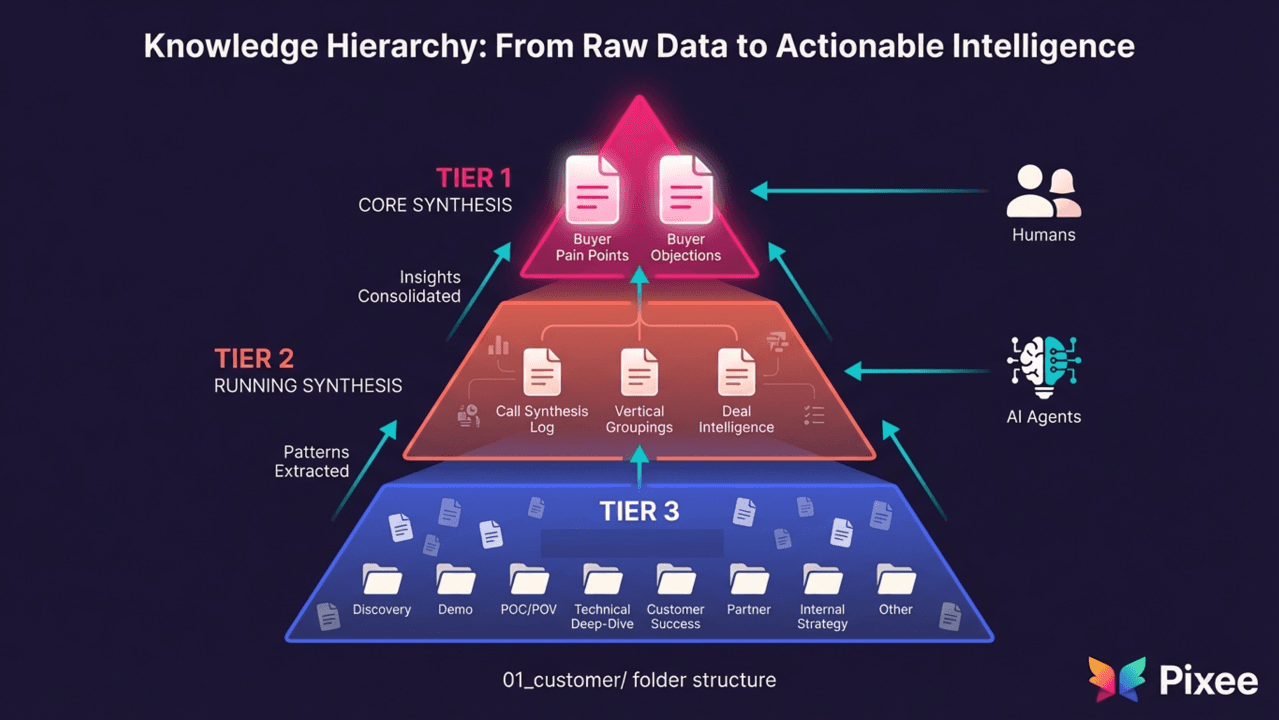
Let me show you how it works using our customer calls as an example:
How Each Tier Works
Tier 3 is the raw building blocks of the customer intelligence folder. Each call has a call synthesizer agent classify the call and create a structured summary on top. Relevant info here like tech stack and MEDDPICC can then get pushed automatically into the CRM. When a sales rep asks "tell me everything about Acme Corp" or "what happened in the last call with Jane?" Tier 3 files can answer that directly. No digging required.
Tier 2 files represent pattern mining and cross-call extraction. You can think of it as AI-maintained running synthesis. "What objections came up this week?" "What are enterprise financial services prospects saying about pricing?" The AI grinds through volume so humans don't have to. (And it creates condensed files that other AI agents can reference more easily than sifting through hundreds or thousands of calls).
Tier 1 is where humans and AI collaborate on canonical documents. AI helps generate and surface the patterns. But the human is the final arbiter. These are the CANONICAL docs: the actual buyer pain points, the real objections with full context, the insights that shape positioning and product decisions. They pull back in from the CRM and other data streams at the company. They get reviewed, refined, and approved by a human before they're considered truth. Someone is responsible for maintaining them.
Why Structure Matters: Traversal and Robustness
The folder organization probably seems pretty intuitive on its own, but the real power is how it can create a context graph across different knowledge domains that is persistent, efficient, and robust. This is usable anti-fragile unique data for your entire company to build on.
The way we do this is to add canonical tags in the frontmatter of every file—what domain it belongs to, the type, the topic, tags etc. Documents then link to each other with wiki-style [[links]]. Synthesis docs reference their source material. Detail docs point up to their parent synthesis.
This creates something more powerful than a file system: a navigable knowledge graph that AI agents can traverse intelligently. It's sort of like a hacked together graph database without the infra build.
The structure also has multiple redundancy points. Missing ten calls doesn't K.O. the validity of canonical documents. Meanwhile canonical tagging means documents can be found by metadata even if specific links break.
This isn't fragile infrastructure. It's a system designed to degrade gracefully and allow for some inaccuracies with agents crafting a lot of the info at lower tiers.
What happens when the ground shifts?
The real power is what happens when canonical documents change.
Within a folder, the flow is straightforward: Tier 3 feeds Tier 2, Tier 2 feeds Tier 1. But canonical documents don't exist in isolation they also feed canonical documents in other folders. So when a Tier 1 doc changes, the system evaluates whether that change should cascade more broadly across the repository (and we have an entire skill built to do that).
Example: Ten calls come in where prospects frame questions around a specific competitor. That pattern bubbles up through customer intelligence and hits the canonical buyer objections doc. The system flags that competitor-related insights should propagate to:
- Competitive intelligence folder — Battlecards and competitor teardowns get updated
- Sales enablement folder — Objection handling scripts reflect the new framing
- Content folder — Blog topics and messaging angles get queued
The graph structure means changes propagate to everywhere they're relevant. One signal, multiple downstream updates.
Side Benefit: Token efficiency and the Pareto principle
Another benefit of this structure is that agents don't need to read everything.
Without structure, agents drown in context. They read everything, burn tokens, and still miss insights. With the pyramid and context graph, agents navigate efficiently. They know where to start, when to drill down, and what counts as canonical truth.
For example when an AI agent needs customer intelligence, it doesn't start by reading hundreds of call transcripts. It starts at Tier 1. 80% of questions get answered right there.
If more detail is needed, the agent follows a wiki-link to Tier 2 docs. That handles another 15% of workflows.
Only when investigating something specific does the agent drill into Tier 3 (and even then, it hits the structured summary first, not the raw transcript).
The pyramid acts as a token filter. Hundreds of calls become ~50 running synthesis entries become ~10 canonical insights. Agents traverse top-down, spending tokens only where needed.
Better Knowledge Architecture
The pyramid is infrastructure that makes AI agents effective at scale.
That's the unlock. Not more AI horsepower. Better knowledge architecture.
Before we built this we were drowning in customer intelligence. Gold buried in transcripts nobody had time to mine systematically (and that our vendors couldn't do in the exact way we wanted). Now its all usable for human and agent alike.